

Key takeaways
- Reactive maintenance addresses equipment failures after they occur, making it practical for low-cost assets where downtime has minimal production impact.
- Many reliability experts recommend an 80/20 split: 80% proactive maintenance for critical assets and 20% reactive for non-critical equipment.
- A computerized maintenance management system (CMMS) helps maintenance teams manage reactive repairs efficiently while tracking failure data to reduce repeat incidents over time.
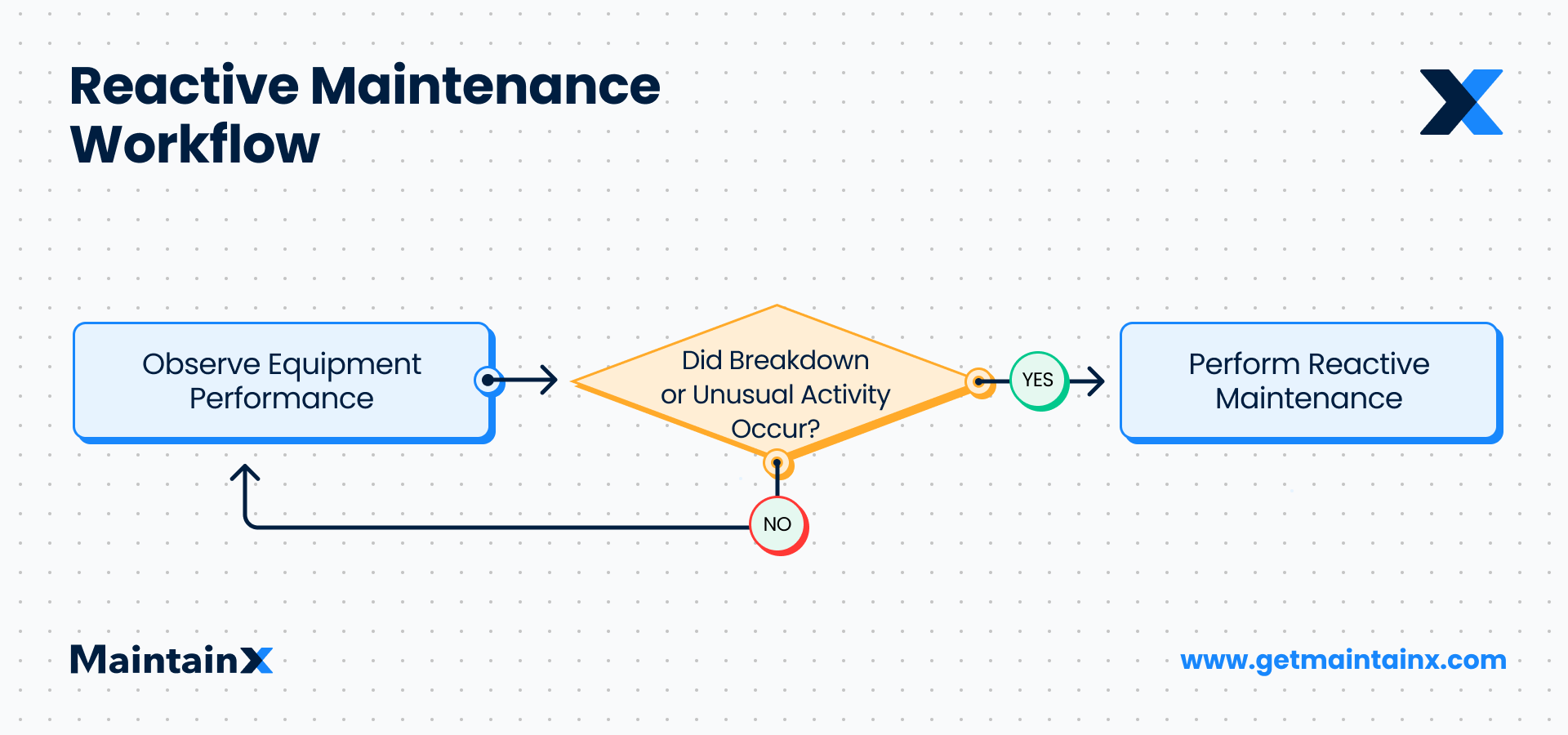
When does reactive maintenance make sense, and when is costing you? Often called "run-to-failure," reactive maintenance refers to the maintenance tasks performed after an asset breaks down.
What follows is a breakdown of how reactive maintenance works, when it’s a logical strategy for an asset, what it costs when misapplied, and how it stacks up against preventive and predictive approaches.
What is reactive maintenance?
When maintenance teams perform repairs after an asset breaks down or stops working, it’s called reactive maintenance. Rather than scheduling upkeep in advance, this strategy means maintenance teams respond to failures as they occur and focus on getting equipment back online fast.
This approach best suits non-critical, low-cost assets where failure has minimal impact on production or safety. Consider a standard light fixture in a non-production area: the most practical approach is to wait for it to burn out and replace it. Scheduling preventive maintenance for that fixture would cost more in labor than the repair itself warrants.
Types of reactive maintenance
Reactive maintenance includes any maintenance activity teams undertake in response to an equipment breakdown or detected degradation. There are three types of reactive maintenance strategies:
Emergency maintenance
Emergency maintenance refers to maintenance activity that must be carried out immediately to restore an asset's operational capacity.
Emergency maintenance activities always take priority to avoid extended shutdowns, ensure safety, and prevent production losses. Factors such as replacement part availability and repair scope directly impact response time.
Corrective maintenance
When an asset develops problems that haven’t yet escalated into a production-disrupting failure, it’s considered corrective maintenance. For example, a piece of equipment begins showing signs of rust, and the maintenance team performs work to remove the rust or replace heavily corroded parts..
Some argue this is proactive maintenance because failure hasn’t happened yet, but any maintenance activity that responds to a detected condition falls under reactive maintenance. Corrective maintenance can be performed immediately upon detection or scheduled later to allow the organization to coordinate resources effectively.
Emergency maintenance is typically more expensive than corrective maintenance because there’s little time to organize resources. It often forces organizations to outsource repair services and pay premium rates for expedited parts delivery.
Run-to-failure maintenance
Run-to-failure maintenance is a deliberate reactive strategy in which teams allow an asset to operate until it stops working before taking any maintenance action. Unlike emergency maintenance, which is unplanned and disruptive, run-to-failure becomes a deliberate call when teams apply it to non-critical, easily replaced equipment.
A maintenance team at a food and beverage facility, for example, might deliberately allow a low-cost conveyor belt roller to run until it fails, knowing they can swap it out quickly without halting the production line. When teams apply it strategically, run-to-failure reduces maintenance labor overhead for assets that don't warrant a full preventive maintenance schedule.
Advantages and disadvantages of reactive maintenance
Reactive maintenance earns its place in the right situations. The problems start when teams apply it to assets that can't afford to fail. According to our State of Industrial Maintenance report, 50% of teams dedicate less than 40% of their time to planned work. This reflects the prevalence of reactive maintenance and the challenge many teams face in transitioning away from it.
The financial consequences of over-relying on reactive maintenance are steep. Poor maintenance strategies can reduce a plant’s productive capacity by 5% to 20%, and unplanned downtime costs industrial manufacturers an estimated $50B annually.
When to use reactive maintenance
While relying entirely on reactive maintenance poses risks to production capacity, it still plays a practical role in a balanced maintenance strategy. The key is identifying which assets can safely run to failure without meaningfully disrupting operations or compromising safety.
Reactive maintenance is appropriate when an asset meets the following criteria:
- The asset is inexpensive to repair or replace
- Its failure does not halt a critical production process
- Operational disruption from its failure is short and predictable
- Replacement parts are readily available in your parts inventory
- Its failure does not create a safety hazard for technicians or operators
A maintenance manager at a food and beverage facility might classify non-critical exhaust fans, standard interior lighting, and low-cost conveyor rollers as run-to-failure assets. These items are inexpensive, readily available from suppliers, and their failure does not stop the production line. Scheduling preventive maintenance for each of these assets would consume time teams could better spend on critical processing equipment.
Documentation is essential to making this work. When teams log run-to-failure assets in a CMMS with pre-stocked replacement parts and a clear repair workflow, they respond quickly without the cost and disruption of true emergency maintenance.
For regional maintenance directors managing multiple sites, this underscores the importance of tracking asset age and condition across facilities. This helps teams flag aging assets for reassessment before they become liabilities.


Examples of reactive maintenance in industrial settings
Reactive maintenance look different depending on the industry and asset type. The scenarios below show how this type of maintenance might play out across common industrial environments.
1. Manufacturing production line
A packaging machine on a manufacturing line jams and shuts down unexpectedly. The maintenance manager on duty responds immediately, dispatches a technician, and the team diagnoses the cause: a worn drive belt. The line is down until the repair is complete. This is emergency maintenance in practice: unplanned, time-sensitive, and directly linking to production output.
For non-critical auxiliary equipment on the same line (a secondary exhaust fan or a low-load conveyor section) waiting for failure before acting could be the more cost-effective strategy.
2. Food and beverage facility
A non-critical exhaust fan in a food and beverage warehouse stops functioning. Because the fan is not part of the primary processing environment and its failure does not affect product quality or safety, the maintenance team schedules a service request for the following day and sources a replacement motor from on-site inventory. This is corrective maintenance: teams detect, document, and plan it without urgency.
3. Facilities management
A facilities team member reports a burned-out light fixture in the storage area of a commercial facility. Because replacement is straightforward and inexpensive, the team logs it as a low-priority task and completes it during the next routine site visit. This reflects the intentional run-to-failure approach: the team allows the asset to fail, and a documented process ensures a quick, low-cost resolution.
Reactive maintenance vs. proactive, preventive, and predictive maintenance
The table below compares reactive maintenance to proactive maintenance approaches (preventive and predictive).
None of these approaches works in isolation. In fact, most programs run all three depending on asset criticality. A CMMS makes that manageable by keeping reactive repairs, PM schedules, and work orders in one place.
Is one approach better than the other?
Reactive maintenance will always occur in some form due to the finite lifespan of machinery and the unpredictability of real-world operating conditions.
Since the initial costs of moving toward preventive maintenance (PM) can be significant, reliability experts recommend prioritizing PM programs for critical assets first. Reactive maintenance then covers non-critical equipment, keeping the overall maintenance budget manageable while protecting the assets that matter most.
Reliability experts commonly recommend the 80/20 framework, drawn from the Pareto Principle, where 80% of maintenance activities are proactive and 20% are reactive.
Balancing reactive maintenance with a smarter maintenance strategy
The bottom line is that for non-critical assets, reactive maintenance remains a practical and cost-effective approach. The goal isn't to eliminate reactive work. It's to make it a deliberate choice, not a default. That means knowing which assets can safely run to failure, keeping spare parts on hand for fast response, and shifting critical equipment onto proactive maintenance schedules.
Reactive maintenance works best as one part of a broader reliability-centered maintenance strategy. CMMS software gives maintenance teams the infrastructure to manage reactive and proactive work from a single platform—logging breakdown repairs as they happen, tracking failure patterns over time, and automating PM schedules for the most critical equipment.
Reactive maintenance in industrial operations FAQs
What are common examples of reactive maintenance in manufacturing facilities?
In a manufacturing setting, reactive maintenance might include replacing a snapped conveyor belt, fixing a jammed packaging machine, or swapping out a burned-out motor on a non-critical exhaust fan. These repairs occur only after the equipment has stopped functioning properly. For non-critical assets, this approach is often intentional and cost-effective, as long as teams stock spare parts and document the response process in advance.
What are the four types of maintenance used in industrial operations?
The four main types of maintenance are reactive (addressing asset failures after they occur), preventive (performing scheduled upkeep to prevent failures), predictive (using sensor data to forecast breakdowns before they happen), and reliability-centered maintenance (a systematic methodology for determining the most appropriate maintenance strategy for each asset based on its criticality and failure modes).
How much does unplanned reactive maintenance cost manufacturing facilities?
Halted production lines, emergency parts shipped overnight, technicians on overtime: the costs of unplanned reactive maintenance stack up fast. Applying a run-to-failure approach to critical assets is consistently more expensive in the long run than investing in proactive maintenance programs from the outset.
When should maintenance managers in manufacturing intentionally allow equipment to run to failure?
Maintenance managers should allow equipment to run to failure when the asset is inexpensive, easy to replace, and its failure does not disrupt the production line or create a safety hazard. In manufacturing environments, common candidates include standard lighting, non-essential ventilation fans, and low-cost consumable components. Logging these assets in a CMMS with pre-stocked replacement parts ensures the team responds quickly and cost-effectively when failure occurs.
.webp)